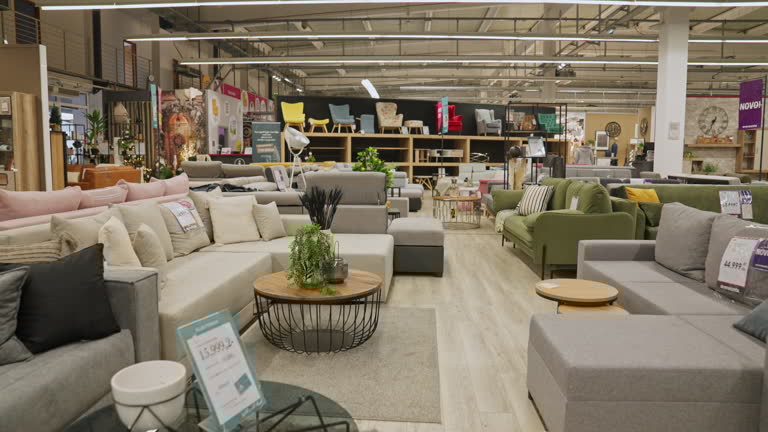
The global Furniture Market demonstrated robust resilience in 2024, achieving a valuation of USD 734.81 billion and is projected to reach USD 757.02 billion in 2025. The industry is set on an impressive growth trajectory, anticipated to expand to USD 1019.54 billion by 2035, registering a steady compound annual growth rate (CAGR) of 3.02% during the forecast period from 2025 to 2035. Despite facing headwinds from geopolitical tensions and supply chain disruptions, the market continues to evolve, driven by changing consumer preferences, technological integration, and sustainability initiatives that are reshaping the furniture manufacturing and retail landscape.
The competitive landscape of the furniture industry features several prominent players who are driving innovation and market expansion. IKEA (Sweden) maintains its position as a global leader, known for its affordable, flat-pack furniture and sustainable practices. Ashley Furniture Industries (US) and La-Z-Boy (US) dominate the North American market with their extensive product portfolios and retail networks. Herman Miller (US) and Steelcase (US) lead the commercial and office furniture segments, offering ergonomic solutions that cater to modern workplace requirements. European luxury brands such as Hästens (Sweden), Natuzzi (Italy), Flexform (Italy), and Knoll (US) continue to command premium market segments, emphasizing craftsmanship, design excellence, and high-quality materials that appeal to affluent consumers seeking bespoke furniture solutions.
North America represents a significant market share, driven by strong consumer spending, housing market dynamics, and the proliferation of e-commerce platforms that have transformed furniture purchasing behavior. The United States remains the largest contributor within this region, with consumers increasingly prioritizing comfort, functionality, and smart furniture integration in their homes and workplaces. The region’s mature market is characterized by frequent home renovation projects and a growing preference for sustainable, locally-sourced furniture options.
Access Free Sample Copy – https://www.marketresearchfuture.com/sample_request/7625
Europe exhibits steady growth, bolstered by its rich heritage in furniture design and manufacturing. Countries like Italy, Germany, and Sweden are renowned for their craftsmanship and innovation, producing high-quality furniture that sets global trends. The European market is particularly responsive to sustainability initiatives, with consumers demonstrating strong preferences for eco-friendly materials and production processes. Stringent environmental regulations in the region have prompted manufacturers to adopt circular economy principles, recycling materials, and reducing carbon footprints.
The Asia-Pacific region is emerging as the fastest-growing market for furniture, driven by rapid urbanization, rising disposable incomes, and expanding middle-class populations in countries such as China, India, and Southeast Asian nations. The region’s construction boom, coupled with increasing investments in residential and commercial infrastructure, creates substantial demand for both mass-market and luxury furniture. Chinese manufacturers are gaining prominence not only in domestic markets but also as major exporters, leveraging cost-effective production capabilities and increasingly sophisticated design capabilities.
Latin America and the Middle East & Africa regions present untapped potential, with growing urban populations and improving economic conditions driving demand for modern furniture solutions. However, these markets face challenges including economic volatility, limited distribution networks, and varying consumer purchasing power that influence market penetration strategies for global furniture brands.
Access Full Report – https://www.marketresearchfuture.com/reports/furniture-market-7625
The furniture market segmentation reveals diverse opportunities across multiple dimensions. By application, the market is divided into residential and commercial segments, with residential furniture accounting for the larger share due to continuous housing development and home improvement trends. Commercial furniture, encompassing office, hospitality, healthcare, and retail sectors, is experiencing growth driven by workplace evolution and the rise of co-working spaces. Material segmentation includes wood, metal, plastic, glass, and composite materials, with wood remaining the most preferred choice for its aesthetic appeal, durability, and versatility. However, sustainable alternatives and innovative materials are gaining traction as environmental consciousness grows among consumers.
Product type segmentation encompasses living room furniture, bedroom furniture, dining room furniture, office furniture, outdoor furniture, and storage solutions. Modular and multifunctional furniture is witnessing increased demand, particularly in urban areas where space optimization is crucial. Smart furniture integrated with technology features such as wireless charging, LED lighting, and IoT connectivity represents an emerging segment that appeals to tech-savvy consumers seeking convenience and innovation in their living spaces.
Several driving factors propel the furniture market forward. The integration of sustainable materials and smart technology presents compelling growth opportunities, as consumers increasingly seek furniture that aligns with environmental values while offering enhanced functionality. E-commerce platforms have revolutionized furniture retail, enabling consumers to browse extensive collections, visualize products through augmented reality, and enjoy convenient home delivery services. Customization trends are reshaping the industry, with consumers willing to pay premiums for personalized furniture that reflects their individual style and spatial requirements. Additionally, the work-from-home trend, accelerated by the pandemic, has sustained demand for home office furniture and ergonomic solutions that support productivity and well-being.
The escalating conflict involving Iran, Israel, and USA military tensions is creating significant ripple effects across the furniture market’s global supply chain. Disruptions to key shipping routes through the Strait of Hormuz and Red Sea corridors are impacting the transportation of raw materials, particularly petroleum-based products used in foam, synthetic fabrics, and plastic components essential for furniture manufacturing. Increased freight costs and insurance premiums are compressing profit margins for manufacturers and retailers who rely on international sourcing. The volatility in oil prices directly affects production costs for furniture companies, while delays in component delivery disrupt manufacturing schedules and inventory management. European and North American furniture brands that source materials and finished products from Asian manufacturers are experiencing extended lead times, forcing them to reconsider supply chain strategies and explore regional sourcing alternatives to mitigate geopolitical risks.
GLOBAL SUPPLY CHAIN & MARKET DISRUPTION ALERT
Escalating geopolitical tensions in the Middle East, particularly around the Strait of Hormuz and the Red Sea, are creating significant disruptions across global energy, chemicals, and logistics markets. Critical shipping corridors are under pressure, with major oil, LNG, petrochemical, and raw material flows at risk, triggering supply chain delays, freight cost surges, insurance withdrawals, and heightened price volatility. These disruptions are increasing operational risks and cost uncertainties for industries dependent on global trade routes and energy-linked feedstocks.
FAQs
1. How is the rise of circular economy principles affecting furniture manufacturing business models?
The circular economy is transforming furniture manufacturing by encouraging brands to design products for longevity, repairability, and recyclability. Companies are implementing take-back programs, refurbishing used furniture, and developing modular designs that allow component replacement rather than complete disposal. This shift not only reduces environmental impact but also creates new revenue streams through furniture-as-a-service models and secondary markets for refurbished pieces.
2. What role does augmented reality (AR) technology play in reducing furniture return rates for online retailers?
Augmented reality applications enable customers to visualize furniture in their actual living spaces before purchase, significantly reducing the uncertainty associated with online furniture shopping. By allowing consumers to assess size, style, and color compatibility in real-time through their smartphones or tablets, AR technology has proven effective in decreasing return rates by 20-30% for retailers who have implemented these solutions, thereby improving profitability and customer satisfaction.
Read Our Related Report:
Pet Furniture Market –
https://www.marketresearchfuture.com/reports/pet-furniture-market-41610
Outdoor Furniture Market –
https://www.marketresearchfuture.com/reports/outdoor-furniture-market-2077
Luxury Furniture Market –
https://www.marketresearchfuture.com/reports/luxury-furniture-market-1305
Office Furniture Market –
https://www.marketresearchfuture.com/reports/office-furniture-market-12521
Smart Furniture Market –
https://www.marketresearchfuture.com/reports/smart-furniture-market-41853